Physical Address
304 North Cardinal St.
Dorchester Center, MA 02124
Physical Address
304 North Cardinal St.
Dorchester Center, MA 02124
Global aviation news tracker
Global aviation news tracker
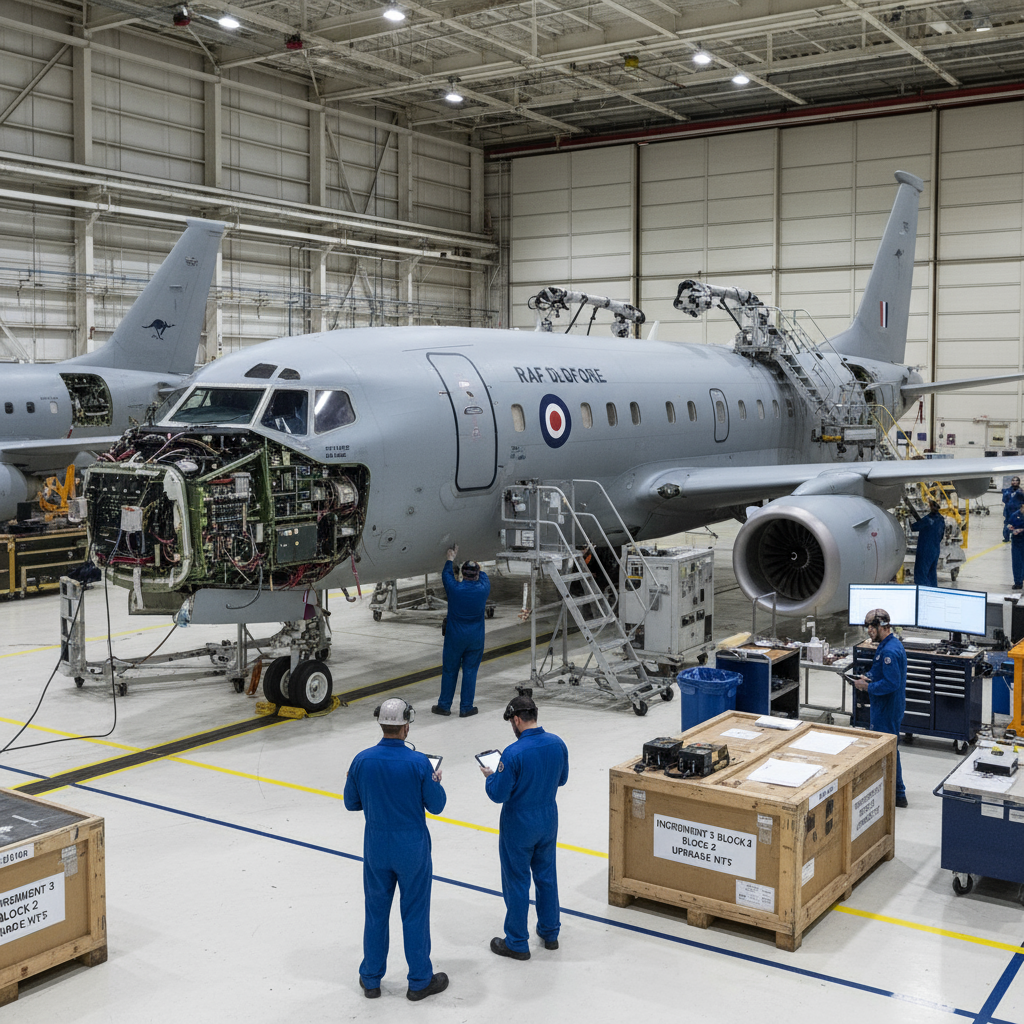
RAAF P-8A upgrades began on October 31, 2025 when Boeing started work to bring the Royal Australian Air Force’s first P-8A Poseidon to the Increment 3 Block 2 standard.
Boeing has started modification work on the Royal Australian Air Force (RAAF) P-8A Poseidon to the Increment 3 Block 2 configuration, a step designed to strengthen anti-submarine warfare (ASW), maritime surveillance and networked operations. The change aligns the RAAF fleet with capabilities fielded by the US Navy (USN).
The upgrade package — known as Increment 3 Block 2 — focuses on sensor improvements, mission system software and data-sharing tools that support wider allied operations. Boeing says the work will enhance the aircraft’s ability to detect, classify and track undersea threats while improving picture-building for allied task forces.
For the RAAF (Royal Australian Air Force), the P-8A Poseidon is the primary maritime patrol and anti-submarine platform. Increment 3 Block 2 brings system commonality with USN P-8A units, making joint operations and logistics simpler between services and improving interoperability during exercises and operations across the Indo-Pacific.
Boeing’s work on the first aircraft began on October 31, 2025, and additional RAAF P-8A aircraft are scheduled to receive the same Increment 3 Block 2 modifications through 2027. The program is framed within ongoing US–Australia defence cooperation to ensure allied forces have interoperable maritime patrol capabilities.
The P-8A Poseidon, built by Boeing, is a militarised derivative of the 737-family airframe configured for long-range patrols, sensors and weapons carriage. Incremental upgrades like this one reflect a move towards common baselines across partner fleets, reducing training and sustainment friction for coalition operations.
While Boeing and the RAAF have released the timeline for these upgrades, specific counts, depot locations and rollout dates for each aircraft have not been publicly detailed. Observers expect the work to be staged to maintain fleet readiness as modifications proceed through 2027.