Physical Address
304 North Cardinal St.
Dorchester Center, MA 02124
Physical Address
304 North Cardinal St.
Dorchester Center, MA 02124
Global aviation news tracker
Global aviation news tracker
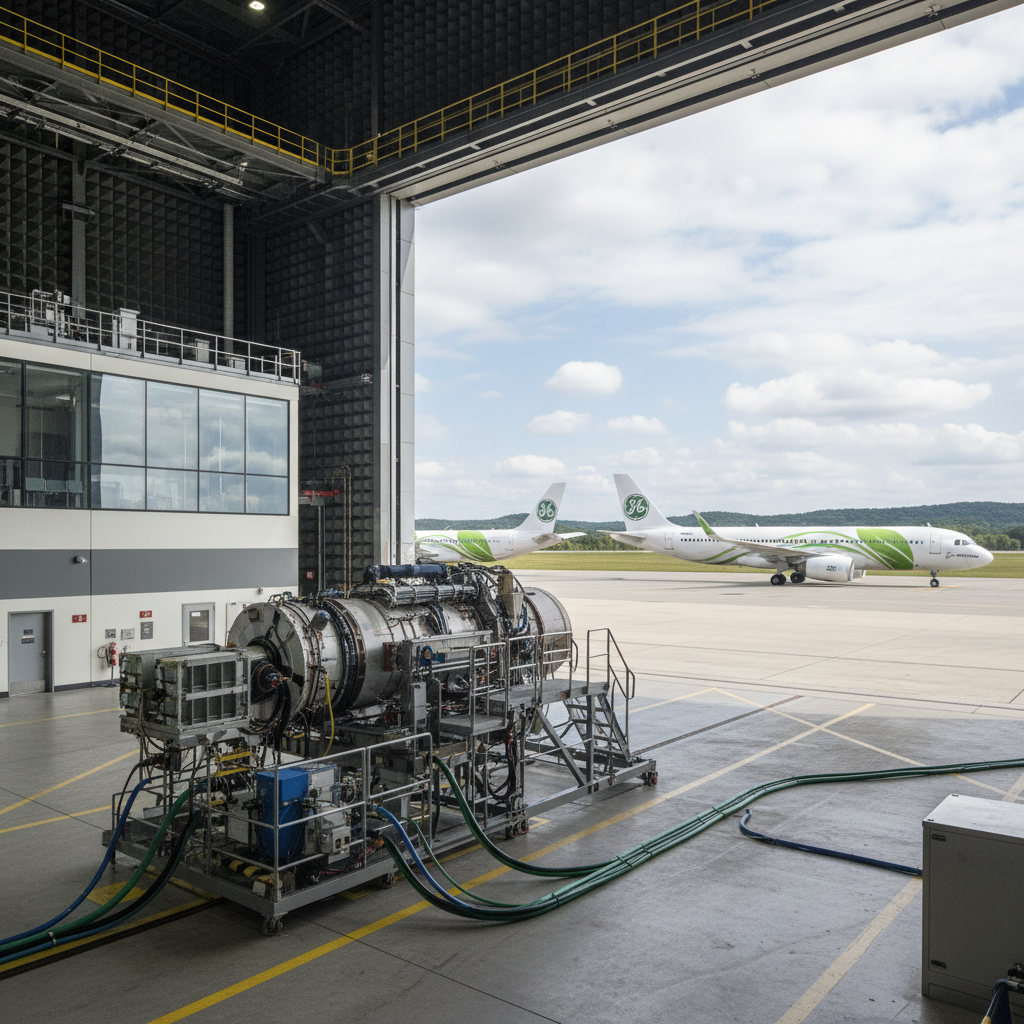
GE Aerospace has begun hybrid-electric engine tests at its Peebles, Ohio site, advancing hybrid-electric engine tests for future narrowbody aircraft.
GE Aerospace (GE) says its Peebles, Ohio, test center is now running a series of hybrid-electric engine trials focused on a mild-hybrid configuration and an adaptive third-stream concept tied to the CFM RISE program. The work targets lower fuel burn and reduced CO2 emissions for future commercial narrowbodies from makers such as Airbus and Boeing.
The program pairs traditional turbofan hardware with electrical systems to offload some power and improve efficiency. GE’s mild-hybrid approach keeps the core gas turbine in primary duty while adding electrical assist during high-demand phases like takeoff or climb. The adaptive third-stream — an auxiliary airflow path — aims to boost thermal efficiency and enable new cooling or bypass strategies without a complete redesign of twin-engine platforms.
Testing at Peebles illustrates how manufacturers and suppliers are pursuing incremental, scalable solutions that fit within certification frameworks and airline operations. Rather than promising an all-electric short-haul airliner, this effort looks to retrofit next-generation propulsion concepts into narrowbody replacement cycles and address tightening emissions standards in the US and Europe.
Industry observers note that work on CFM RISE (the collaborative development route for next-gen propulsion) and related hybrid architectures could influence engine choices for future A320/A220 and 737-class replacements or derivatives. GE’s test campaign is an early but concrete step: physical test runs help validate models, cooling strategies and integration paths for airlines and OEMs (original equipment manufacturers).
Next steps typically include longer-duration bench testing, system integration trials and, eventually, demonstration on testbed aircraft. If the concepts scale as hoped, airlines could see measurable fuel and emissions benefits on narrowbody fleets during the 2030s as regulatory pressure and sustainability goals intensify.