Physical Address
304 North Cardinal St.
Dorchester Center, MA 02124
Physical Address
304 North Cardinal St.
Dorchester Center, MA 02124
Global aviation news tracker
Global aviation news tracker
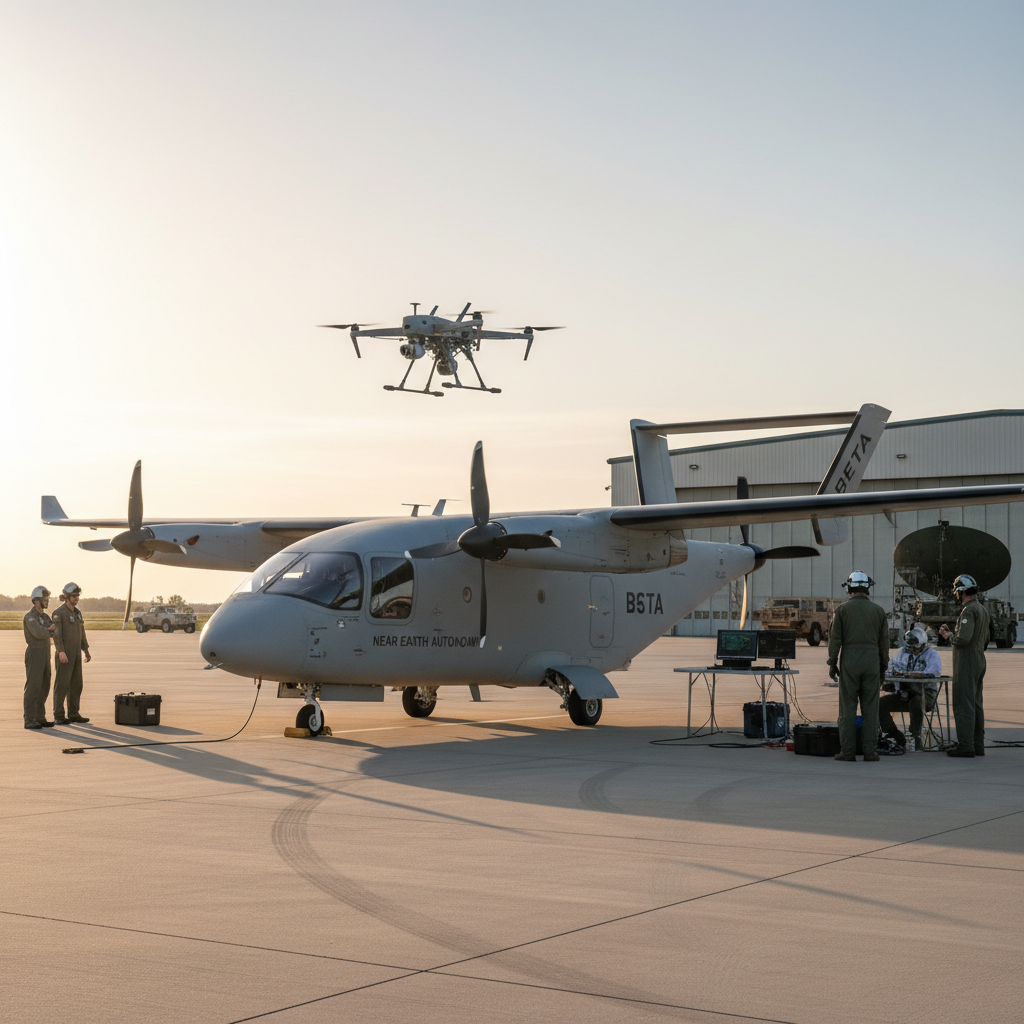
Beta Technologies and Near Earth Autonomy announced on November 24, 2025 a push to bring autonomous VTOL capability to the MV250 for defense use.
Beta Technologies selected Near Earth Autonomy to develop advanced autonomy systems for its MV250 hybrid‑electric VTOL cargo aircraft. The collaboration, revealed on November 24, 2025, focuses on rapid integration of software, sensors and flight‑control logic to enable extended‑range, unmanned operations in contested environments.
The MV250 is designed as a hybrid‑electric vertical takeoff and landing (VTOL) cargo platform intended for long‑range logistics and surveillance roles. Beta says the platform’s architecture aims to support remote or optionally unmanned missions; Near Earth Autonomy will work on autonomy stacks to improve navigation, obstacle avoidance and mission management under degraded communications.
For militaries, autonomous VTOL systems promise lower risk to personnel, faster tactical resupply and persistent observation without relying on conventional runways. Beta Technologies and Near Earth Autonomy describe the effort as a step toward robust unmanned logistics in contested or denied airspace, though specific operational timelines and government customers were not disclosed in the announcement.
Both companies bring complementary expertise: Beta Technologies in aircraft design and systems integration, and Near Earth Autonomy in perception and autonomous navigation software. The partnership aims to accelerate testing cycles, expand safety validation and mature the MV250’s mission systems for defense scenarios while following applicable certification and export controls.
Expect incremental milestones rather than an immediate fielded unmanned system; the announcement frames this work as a multi‑phase development program to validate autonomy performance across a range of mission profiles and environments. Public details are limited to the November 24, 2025 statement, with technical specifics to be revealed as testing progresses.